The Obsession with Coming in Second
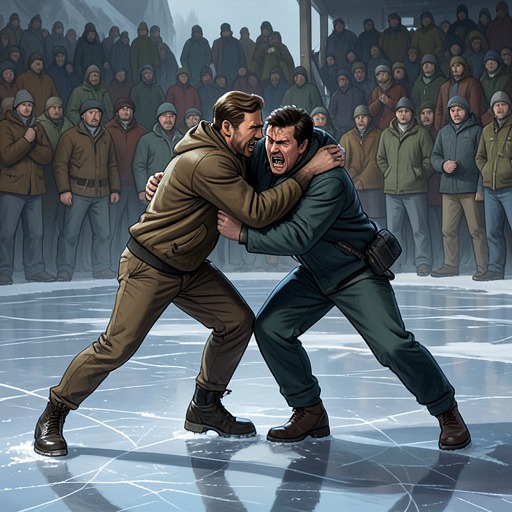
Heated RivalryThe Obsession with Coming in Second is the recurring pressure of being measured against Ilya Rozanov—and, for Shane Hollander, the sting of coming after him despite a lifetime of hockey success. It begins with a concrete reversal of Shane’s expected place at the top: Rozanov is drafted first and Shane second. The idea then expands beyond draft order into medals, awards, and public debate, while the story’s hidden relationship between the rivals exposes how little a league table can explain about what matters between them.
The First Reversal
At the draft, Shane has ample reason to regard himself as an exceptional player. He and Rozanov have captained their respective teams, led them to championship games, and earned league and playoff MVP honors; each has also led his league in scoring. Yet the comparison that fixes itself in Shane’s mind is stark: Shane has a silver medal, while Rozanov has gold. After a life of always coming first in hockey, Shane experiences the second overall pick not as a minor distinction but as a break in the order he expected his career to follow.
The reversal does not make Shane’s selection a bad outcome. He is drafted by a storied Montreal team only a two-hour drive from his hometown of Ottawa, and the fit suits his fluency in French and English and his respect for the club. Those advantages do not erase the hurt of being selected second. The concept rests on that coexistence: Shane can recognize that he has landed in a desirable place and still feel the rank itself as an injury.
Rozanov’s position sharpens the comparison. He is not merely a rival who has beaten Shane in one game; he is the player placed ahead of him at the moment their professional futures are publicly assigned. Shane has spent the six months since the World Juniors becoming somewhat obsessed with him. Their parallel achievements make the difference between them seem almost arbitrary, but the gold medal and first pick give that difference a visible form. The rivalry therefore begins with both likeness and hierarchy: they are matched in accomplishment, yet the public record gives Rozanov the higher place.
A Repeated Score, Not a Simple Verdict
The fixation is reinforced by the way hockey converts performance into results that can be counted. A medal distinguishes gold from silver; a draft order distinguishes first from second. These measures are meaningful, but they compress complicated seasons into a single standing. Shane’s sense of coming second is especially potent because it occurs alongside his success, not in place of it. He has not failed; he has excelled and still found himself behind Rozanov.
The pattern is not exclusive to Shane. In another early-rivalry context, Rozanov loses and returns to Russia with a silver medal, a result he is not proud of. He wants to stay in North America and begin the next stage of his life, away from his father’s judgment and the weight of family and country. The parallel complicates any simple division in which Shane is the disappointed runner-up and Rozanov the effortless winner. Both can be caught by the same medal’s meaning, even though the draft initially assigns them opposite positions.
By June 2011, the comparison has become a public question as much as a private grievance. At the NHL Awards in Las Vegas, the leading discussion is who will receive the Rookie of the Year award. Shane and Rozanov have each scored exactly sixty-seven goals, helped their teams reach the playoffs for the first time in years, and been eliminated in the first round. Fans and the press debate which player is better, but Shane recognizes that the question has no definitive answer. Winning the award would nonetheless feel good. The scene brings the obsession into focus: even when the numbers are equal, a prize can promise a temporary resolution to a rivalry that the numbers themselves cannot settle.
Rivalry as Public Narrative
The league’s attention helps turn two young players into a comparison. Before their first NHL meeting, Shane thinks the buildup is excessive: they are both nineteen, and their professional careers are only weeks old. His father describes the league’s interest as a search for a marketing angle and treats the matchup as an ordinary game. That exchange reveals a gap between the contest itself and the story built around it. Shane is already intent on proving himself against Rozanov, while the league and its audience give that intent a public frame.
The first meeting therefore carries more weight than its place in the season might warrant. Shane has watched Rozanov play to the camera and wants to shut him up when their teams finally meet. But the rivalry’s publicity is not only an obstacle or a source of pressure; it also supplies a ready-made explanation for the attention the men give each other. Their careers can be discussed as a contest, even as the private significance of their connection remains undisclosed.
That public rivalry acquires a more complicated meaning in light of Shane’s later account of his fear. He says that being attracted to his archrival while he is eighteen—and while that rival is a man—terrifies him. He also describes the relationship as nearly ten years old, correcting the assumption that it is new simply because others have only recently learned about it. The measurable contest and the concealed relationship run alongside one another, but they are not equivalent: draft order and goals can be announced; the personal stakes remain secret for years.
What the Ranking Cannot Measure
The hockey world offers Shane a language of placement, achievement, and comparison. It offers no similarly safe public language for his sexuality. He understands that a professional player’s coming out would require considerable bravery, given the homophobic slurs he hears on the ice and in the dressing room. He does not intend to be the first openly queer player. In that environment, being second in a sporting ranking is painful, but being first to disclose a stigmatized identity is a different and much more dangerous prospect.
The surrounding scenes make the contrast concrete without turning private life into another scoreboard. An opposing player directs a homophobic slur at Rozanov, who responds by treating it as partly true and then qualifying that response with a percentage. The exchange is flippant, but it occurs within a culture in which Shane believes disclosure carries serious risk. Later, when Shane’s father realizes how long Shane has held the secret, the duration itself becomes newly visible to the family. These moments show that the public rivalry can be named and debated while the relationship and the fear surrounding it remain hidden.
The concept’s significance is thus both personal and structural. Shane’s attention to second place arises from his own competitive history, but it is intensified by a sport that repeatedly turns players into comparable statistics and public rankings. The story first makes that pressure legible through the draft and the gold-and-silver contrast, then complicates it with tied goal totals, rival interpretations, and a relationship that cannot be reduced to who leads. The obsession is not simply a wish to defeat Rozanov. It is the ache of being defined by comparison—and the eventual recognition that the most consequential parts of their lives have been taking place outside the rankings.